Sunday, July 20, 2014

My experience in Ghana

It's been a while since I last wrote anything after I returned from Ghana; life has been busy as I've been getting back to research (somewhat successfully) and attempting to get back into shape for some key races in the late summer and fall without injuring myself or burning out (mostly successfully).  This post will have little to do with either of those things, though, as I'll try to write about my experiences in Ghana before I completely forget everything that happened.

The trip to Ghana includes a short flight to New York City, followed by an 11-hour flight across the ocean.  My previous experience with flying was next to nothing; I had my first real flight back in February, an hour flight to Washington, D.C.   I figured this flight would cause problems for me, as I have an inherent fear of sleeping in moving objects, let alone moving objects flying at 30,000 feet across a large body of water.  Bracing myself for a long night/day, I was fortunate to at least have an aisle seat so I could get up and move around every so often.  Unfortunately, I did not fill up enough water bottles before heading over, so I landed in the capital city of Accra tired, cranky, and dehydrated.  It did not help that we landed in the mid-afternoon, when temperatures were in the mid-80s and humidity was high. After we made it through the airport, we found cabs to get us to our accommodations.  Over the 10 mile (40 minutes in traffic) drive, the differences from cities that I'm used to jumped out at me.   There are not a lot of very tall buildings. Many buildings are less than two or three stories, and many homes are single-storied, packed closely together, and covering a small area.  

One of the villages.

Traffic protocol is somewhat different.  Traffic lights are somewhat rare, and drivers seem to take more risks (speeding, passing) without fear of causing a problem.  (Surprisingly, I only saw one accident during the entire trip, which made a 12 mile drive close to three hours).  Once we finished traveling for the day and had dinner, I considered doing a short run but did not out of fatigue.  So ended the run streak that began in late September.  (I did run every remaining day that I was there, but some places were better for running than others.  While in Accra, all of my miles were run on a 150-meter balcony.  In general, the persistent humidity and heat made running difficult for the most part, but I managed.)

We planned our trip to make stops in several areas around Ghana.  As for a size comparison, Ghana is roughly the area of Pennsylvania and New York combined.  Many of the distances that we traveled were not very far, but the time to travel between these places was longer than what I have been used to in the United States, as there are no highways in Ghana like the highways in America.


Rough map of our travels while in Ghana.

We also happened to travel to Ghana during the start of the rainy season.  Some days it rained a lot.


Our trip, especially the later parts, had many sudden heavy downpours.  We were lucky to be near shelter most of the time!

While in Accra, our main goals were to prepare for the solar panel workshops that we would be conducting in Kumasi and Takoradi.  At each of these workshops, we planned to teach the kids how to assemble both large solar panels that could power small appliances, such as a light bulb, and small panels that could be able to charge a cell phone.  We brought the silicon cells with us, but we had to buy the remainder of the materials, like wood, paint, and glass, in Accra.  In America, this could be as simple as going to one's favorite home improvement store, buying the materials, and calling it a day.  This was not the case in Accra.  The market is open, haggling over a price is common, and one would have to go to several places to buy everything that we would need.  Fortunately, we found some taxi drivers who knew their way around the area well, so looking for all of the supplies that we needed was not nearly as much of a struggle as it could have been.


One of the markets in Accra.  Vendors line the streets and even crowd the sidewalks. 

We took a brief trip from Accra to Akosombo, where we visited the dam of the Volta River.  This is a major source of hydroelectric power for a large part of Ghana as well as nearby Togo. 


A distant view of Lake Volta and the dam.  Lake Volta is HUGE.  It's one of the largest reservoirs in the world; look at the map above.

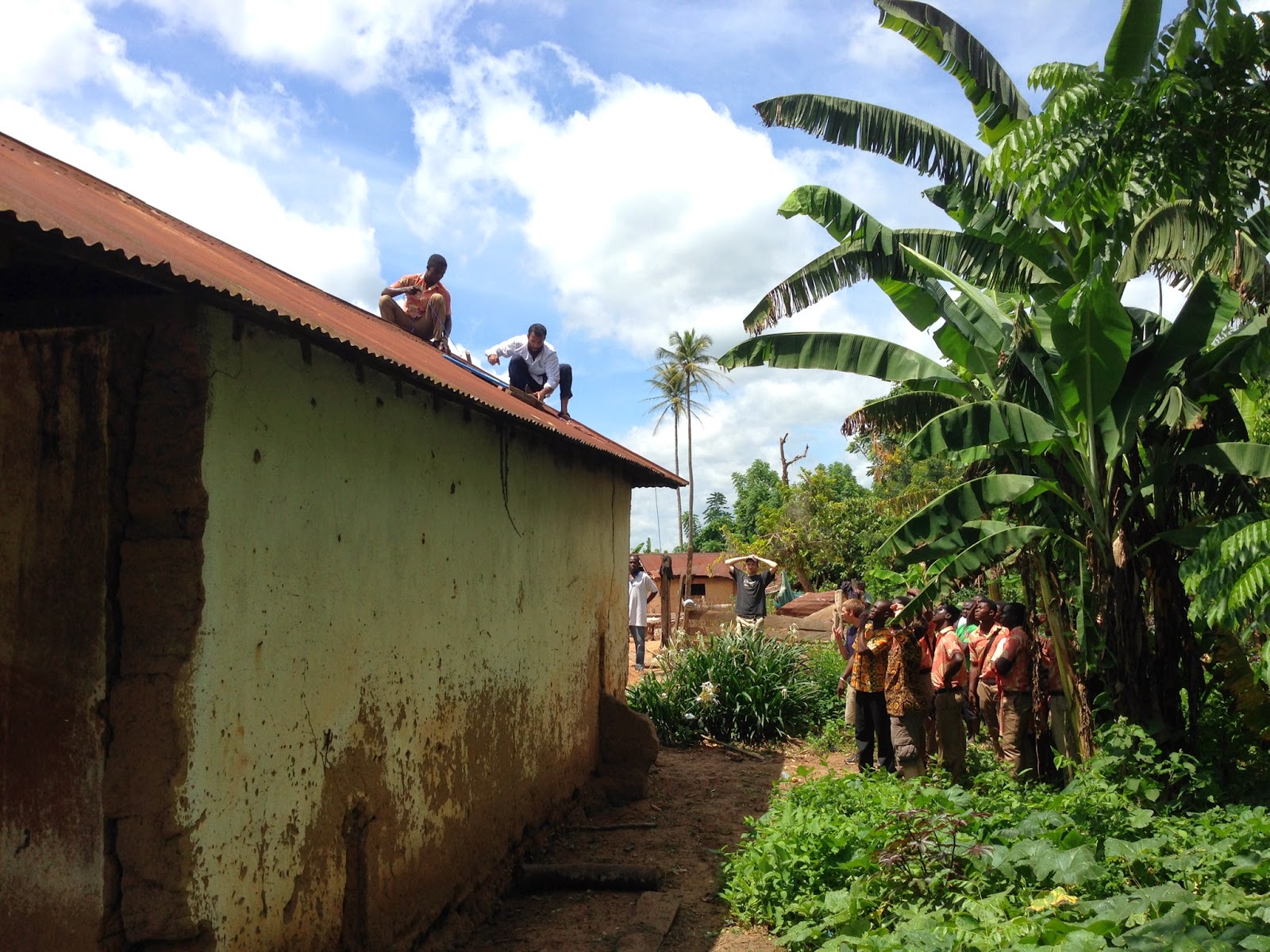
We next went to Kumasi to start our first workshop.  The plan was to spend four days at Kumasi Technical Institute teaching kids how to assemble solar panels, as well as teaching them some of the physics of the solar cells and the business of the solar power industry.  Then, on the fifth day, we would go to an off-grid village to install a solar panel.  Unbeknownst to us, however, was that the first planned day was African Union Day, a holiday in Ghana; this shortened our workshop by a day. Fortunately, the kids were very hard-working, and we finished all of the panels on a shortened schedule.  We went to a village that wanted a source of power for a light bulb so that travelers could see the houses on the side of the road.

Soldering some cells together.


Applying a protective layer to one of the solar panels.


Putting the panel on a roof.  I did not climb up there.
The final result.

After a brief trip to Sunyani to visit the University of Energy and Natural Resources, we made our way to Takoradi for another workshop.  Having one workshop under our belts already, this one went even more smoothly.  However, the trip to a different off-grid village was a lot more interesting.  The road to the village came to a small stream that our bus could not cross about a half of a mile from the village, which meant we had to walk, supplies and all, the rest of the way.  Then, less than a quarter of a mile from the village, a pond blocked the road.  Some waded, but I decided to take up the offer of a piggyback ride.
The bus is starting to struggle on the roads...
Time to go on foot.


The final obstacle to the village.


Another successful installation.

During our last week in Ghana, we visited Kakum National Park, where we embarked on a canopy walk. We also visited the slave castles in Elmina and Cape Coast.  These were were slaves were held until they were taken elsewhere.
An unfortunate flat tire on our way to Kakum.  We were still on one of the main roads, and fortunately, some local residents came to help us. We were good to go in no time!


One of the bridges on the canopy walk.


The slave castle in Cape Coast.  Very heartbreaking to see the cramped, hot conditions of the chambers in which people were held for months at a time.


The castle was right on the coast and had cannons (which were supposedly never used) to fight invaders.

I was not as fortunate for the return flight, as I had a window seat and did not have the luxury of moving around freely.  However, the flight seemed to go by quickly, and soon enough, I was back home.  Overall, the trip was a very rewarding experience.  I was extremely nervous to go, and I was almost tempted to miss my flight in the first place.  However, I'm glad I got on that plane and saw what life was like in a much different country from my own.

Thanks to Francis Smith for most of these pictures.

Monday, June 16, 2014

The international journey that almost wasn't

Two years ago, I applied for and received an internal university fellowship as a part of the IGERT program.  The goal of the program was to give engineering Ph.D. students experience with business and public policy and not just focus on "pure science".  One of the stipulations of the fellowship would be to travel to Ghana for a month sometime during the spring or summer of 2014 to teach.  This was a huge undertaking for me.  As of two years ago, I had never traveled by plane, never left my time zone, or never left the country (aside from a very brief trip to Canada, which I don't count since it was back before one even needed a passport to visit).  Since the trip to Ghana was so far in the future, I thought little of it.

Fast forward to September 2013, when the initial planning stages for the trip began.  Thinking ahead, I also wanted to try to do a spring marathon before I left the country. Because I thought the trip would be during August, my original plan was to run the Buffalo Marathon at the end of May to redeem myself after my first attempt there, run some races over the summer, then head to Ghana.  However, it was decided that the trip would be moved up to May and June; even with dates unspecified, this made Buffalo seem very unlikely.  I started to search for another one.  At the end of November, I talked to another runner back home, who recommended the Gettysburg Marathon to me.   I looked into it, and I decided to try it.

Throughout the next few months, I ran a lot, spent long days and nights in lab, consumed more caffeine than I would have liked, wrote a lot about the results of the long days nights in lab, submitted a paper to a journal, got rejected from that journal, submitted to another journal, finished my Master's, and continued to plan for the trip to Ghana.  Dates were finalized: we would leave for Ghana on May 15th, roughly 2.5 weeks after the Gettysburg Marathon.  It looked as though my training and the trip were all coming together, until about three weeks from when we were supposed to leave.

We received an call from the Embassy, saying that they could not process our visas!  Since that was right before race weekend, I thought little of it and ran the marathon, a new PR by almost 4.5 minutes.  I was not sure how many opportunities I would have to run in Ghana, so I decided to not take too much downtime just yet.  We tried contacting the Embassy with little luck.  After a week, a dangerous thought popped into my head: if I didn't get a visa and couldn't go to Ghana, I could still follow my original plan and run Buffalo. This seemed kind of crazy, but when crazy ideas get into my head, sometimes I decide to follow through with them.  I decided to test my recovery at the Bill Lawler 5K, six days after the marathon.  Somehow, I managed a 15:50 and decided to go ahead with a "retaper".  Another week passed, and I still didn't have a visa.  Five days before my planned flight date, I ran the CP Rochester Run for Fun 5K in 16:17.

It seemed as though running another marathon would be a legitimate possibility until two days before the flight date.  Other members of the group traveling to Ghana physically flew to Washington, D.C., explained the situation, and left with all of our visas in hand. Thus, my crazy idea came to an end.  It was kind of a downer after I had psyched myself up for it, but it was probably for the better.  Two marathons in a month?  I'm not built for that...yet.

Ghana was a very eye-opening experience, between the teaching, traveling, and running, enough for another post.  I'll close by mentioning that I decided to race the Medved 5K to Cure ALS the day after I returned from Ghana.  Between the lack of sleep, lack of real training, and jet lag, I didn't know what to expect.  Although my 16:34 wasn't amazing (15 seconds slower than last year), I'm still pleased with the result.  Roadkill as a whole had a great showing at the race too! The trip to Ghana was a huge unknown factor, as I didn't know how much I'd be able to run while there, if at all.  There is much work to be done, but I feel that I've maintained a decent amount of fitness.  Here's to getting fast this summer for Bergen!

Credit: Matt Roberts


Tuesday, April 29, 2014

Gettysburg North-South Marathon

Get ready.  This might be a long one.

After a harsh training winter, it was finally time for the Gettysburg North-South Marathon on April 27.  The race was fairly small; there were 465 finishers this year.  Over a hilly course, each runner chooses a "side" to be on (North versus South).  The top male and female times for each side are added, and each member of the winning side gets a mug (spoiler alert: the North won).

I had done the best that I could with my training this winter, and I felt that this race would be my first legit shot at a sub-2:30 marathon. Fitness-wise, I felt that I was there.  However, the nature of the course would definitely present a challenge.  Here is a link to the map.   The course generally ascends early in the race, reaches its highest point soon after 7 miles, ascends once more before mile 11, then descends for the majority of the second half of the race.

I always try to have a few goals going into a big race.  My top goal for this one, if everything went perfectly, was to run under 2:30.  This would be a stretch, so my next goal was at least to PR, which meant running faster than 2:35:30.  I felt that this would definitely be doable, but in case something went horribly wrong on the course, my final goal was to be faster than 2:40.  This would at least convince me that my time under 2:40 from last year was not a fluke.

The conditions on race morning were near perfect.  At the start of the race, the sky was clear and the temperature was in the low 40s.  The only potentially unsettling aspect was the wind.  The wind wasn't strong enough to be a pain, but it was strong enough to be noticeable.  My dad came with me to the race, and he was planning on biking out to the 11th mile mark, which was also close to the 18th mile mark.  The other runners and I gathered to the starting line, and soon after 7:30 AM, we were off.


Starting off focused.  Credit: Ken Goodfellow

I knew that I had to stay in control early if I wanted to hit my goals.  Most of the uphills were in the first 11 miles of the course, and I figured that these miles would be my slowest.  There were three major climbs that I initially worried about, the first of which occurring just before the first mile marker.  I wanted to run the first mile no faster than 5:50; I made it in 5:52.  Excellent. (I don't remember all of my splits, as I had more important things on my mind, but I remember a fair number of them, give or take a second).   Soon after that, I started to pull away.  This started to worry me, as I was then through two miles in 11:22.   I made it to the first water station, gave the volunteer a Gatorade shower, decided I needed to work on my handoffs, and split through three miles around 17:20.  Confused at my pacing, I continued at the same effort, and after a couple more widely-spread splits (a low 5 and a low 6), I was through five miles in 28:45.  At this point, I was approaching the second hill on my worry list.

Soon after six miles, the lead bike backed off a little bit to chat with me.  We talked for a bit about my goals for the course, how I had to work on my aid station drinking, and how I wasn't worrying about pace until after 11 miles, but what surprised me was that I was easily talking!  This seemed to be a good sign for my effort level.  After cresting the big hill after mile 7, I split through 8 miles in 45:20.  I knew these next couple of miles would be a little quick before the final large hill during the 11th mile, and surely enough, after another brief, unforced conversation with the lead biker, I was through 10 miles in 56:30.  I still felt great up to this point, but I still had a whole lot of race left.  I made it up the final hill to the end of the 11th mile, the point where my dad saw me for the first time in the race.  I was through 11 miles in 1:02:32; I told myself before the race that I should be through 11 in no faster than 1:03.  I wondered how long this would last and kept pressing on.  


Just after 11 miles, with most of the hills behind me and still feeling strong. Credit: Ken Goodfellow
Another few miles flew by, and soon enough, I was through the half marathon in 1:14:06 (~5:39 per mile).  This was on the lower end of my goal time; I was hoping to be through the half between 1:14 and 1:16.  (On a side note, at this point, I thought about the Flower City Half Marathon, which was going on at the same time.  My two slowest half marathon times are at Flower City, and I wondered how my split would have stacked up this year.  Turns out, 1:14 would have placed 2nd.)  Along this next mile was one of the most dense spectator areas, which definitely helped to boost my confidence; aside from the pace bike, I was still alone.  Unfortunately, soon afterwards, I had a little bit of a momentum killer. Soon before the end of the 15th mile, one of the road marshals at one of the crossroads (at which I had to go straight) shouted at the pace biker "Hey, marshal!" to get his attention after we passed.  We both turned to look, and the road marshal seemed to make a movement with his flag up one of the side roads! Confused, I SLOWED briefly and yelled "Is this the turn?", to which the response was "No."  Great.  I regained momentum while the biker talked with the road marshal.  The biker quickly caught back up to me, and all was good, or so I thought.  Soon after finishing 15 miles, we turned (onto the correct road), but there was no one to direct other runners.  The biker made a phone call, and he was instructed to go back.  I finished 16 miles in 1:30:39, and now I was truly alone.

I continued to push on for the next few miles; the worst part of the course was already behind me.  There was another small spectator crowd, including my dad, during mile 18.  Over the next few miles, my pace stayed fairly steady and I felt comfortable over the downhills, but I lost track of my splits until I got to mile 21: 1:59:29 (~5:41 per mile).  I had slowed down a little bit over those last few miles.  Doing some quick on-course mental math, I realized that a sub-2:30 was still within reach, but I didn't have a whole lot of wiggle room.  (Sitting at my computer now, I can now calculate that I had to average 5:52 for the last 5.2 miles to be under 2:30.  A little more wiggle room than what my race brain was telling me but still not a lot).  Things would have to go pretty well for the rest of the race.

Things didn't go well.

Very soon after finishing 21 miles, I got a pain in my side that I thought was a cramp. Over the next half of a mile, it quickly progressed from "ouch" to "S*** this is unbearable!". Soon after, I did something I never thought I'd do: I stopped.

At this point, my inner dialogue went in all sorts of directions, from "What the f*** are you doing!?!" to "It's okay, you tried" to "Just take a break for a few seconds" to "But you're less than 5 miles from food!" (Yes, for some reason, in one of the most unsettling moments of my racing career, I was thinking about food).  I listened to the last two and started to run again after about 10 seconds.  The pain was still very present, but I could run with it.  I finished 22 miles in 2:06:32; the combination of stopping and the reduced pace when I started again cost me over a minute!  I continued to regain some momentum through the pain.  Right before the aid station before the end of the 23rd mile, I decided to look back.  I'm glad I did, but part of me wishes I hadn't.  In the distance, I saw another runner coming in hot with a biker. I figured I only had about a minute of lead at that point, if that.  I got to the aid station, threw Gatorade at my mouth for the last time, and went to work.  I pushed even more through the pain as I crossed 23 miles in 2:12:22.

Just over 2.5 miles to go and in pain. Credit: Ken Goodfellow

I saw my dad for the last time at the turn right before the end of the 24th mile.  (He later said that I still looked great and did not see the approaching runner). At this turn, I looked back and saw that I maybe had 30 seconds of lead, and I started to worry.  At this point, I also noticed that it was starting to get a little warm, but that was irrelevant.  I had to focus for the next 2.2 miles.  I continued to push and did not take any fluid at the final aid station right before the end of 25 miles, as that would likely not help and just slow me down.  I got through 25 miles and started to surge, or at least I attempted to.  Finally, after 25.5 miles, the runner caught me and soon passed me, and for the first time, I was not leading the race. I pushed to try to stay with him, but it was to no avail.  I tried several more times to surge, but the gap kept growing.  I made it through 26 miles (and I don't know why I looked at my watch) in 2:29:43, made the last turn, and watched the winner cross the finish line.  About 25 seconds later, I crossed the finish line in 2:31:08.  As it turns out, the top three runners all broke the old course record.


Finally almost finished. Credit: Gettysburg North-South Marathon

It was kind of disappointing that a cramp cost me a sub-2:30 marathon and the win, but it's all too easy to look back and be speculative about what could have happened differently.  No matter how well preparations for a marathon go, anything can happen to anyone over 26.2 miles.  Almost everything that I could control went as well as it could have gone.  My training this winter went well considering the weather, and my volume was about as high as I could go safely before risking overtraining or burnout or increasing my chances of injury greatly.  My nutrition before and during the race was excellent; I never felt like I "hit the wall" and had enough energy to keep going.  My pace early in the race may have been a little aggressive, but from an effort standpoint, I was not straining to maintain pace, at least before the pain in my side hit after 21 miles.  My time was a PR by 4 minutes and 22 seconds (about 10 seconds per mile). In all four of my marathons so far, I've run a positive split for the second half, but this positive split of just under 3 minutes (1:14:06/1:17:02) was my smallest one yet (my others were ~3.5 minutes, ~9 minutes, and ~20 minutes).  Every marathon is a learning experience, and this race is another step towards greater things to come.

So what's next?  I'll take a bit of downtime and maybe jump into a race for fun, but my first real summer fitness "assessment" will be the MEDVED 5K to Cure ALS in mid-June, and the focus will be shorter races at least until the Bergen Road Race in early August. I'm not sure what my next marathon will be, but I'm considering finding a flat, fast race this fall for (hopefully) sub-2:30 attempt #2!  We'll see. 

Special thanks to Ken Goodfellow for coming to support me and to Roadkill Racing for letting me run in an awesome singlet and for a great team.

Thursday, April 24, 2014

Taper and pre-marathon thoughts

It's finally here! I'm only a few days and a couple of easy runs away from my next marathon in Gettysburg. The field is about 600 runners, so it's a little bigger than my last marathon (less than 400 total finishers). It's been a tough training winter, but I've done the best that I could.  I'm approaching the end of my taper, and this taper has been less frustrating than what I've remembered in the past.  Tapering is not an exact science, and cutting back mileage to try to strike a balance between being optimally-rested while losing the least amount of fitness is tough.   I'm a fan of the three week taper, but in the past I've mostly forgone workouts of almost any kind during the taper period, aside from one or two short marathon-paced runs.  All of that easy running let me feel rested, but towards the end of the taper, I would REALLY have to restrain my normal pace-pushing self to not crush every run.  This time, I included a few workouts and a race:

At the end of the first taper week, I ran the 10,000 meter run at the ROC City Classic as a final tune-up for the marathon.  Due to the general lack of 10Ks that I've raced since college, my PR of 33:32 was over three years old (although I did tie this during one of the Freezeroo races this year).  At the very least, I was hoping to run a new PR and break 33:00.  Talking with Dave the day before, I mentioned that if everything worked perfectly, 32:30 would be a possibility.  I initially thought of going out in 16:00-16:15 for 5K, but due to the small size of the field, this would likely mean that I would be alone in a suicide quest.  I planned to stay with the pack for 5K and go from there.  Of course, the race started and plans unraveled quickly; I hit the 5K split in 16:02 and got a little scared.  Although I slowed down a bit over the second half of the race, I still crossed the finish line in 32:28 for a huge PR.  For the end of a still fairly high-mileage week, this was a good sign.


Kicking in to a new PR.  Photo credit: Matt Roberts


The second taper week included more of a cutback in mileage, but I also wanted to included a little bit of intensity, more to increase mental confidence than increase fitness.  I included an eight-mile marathon pace(ish) run but also tried a track workout. The goal was 3 miles (17:00), 2 x mile (5:15 each), 2 miles (11:20) with rest in between.  The paces would be fast enough to be beneficial without being too taxing.  Instead, feeling good and employing my normal lack of restraint when that happens, my times ended up being 16:30, 5:07, 5:10, 10:50.  The paces didn't feel like I was pushing, and the workout was a good confidence booster, but I'll see if or how these paces (still 10 days out from the race) affect me.

I always have worried about the final week of the taper, despite all of the training being behind me.  I don't want to run too much to be tired on race day, but I also want to run enough as to not feel flat.   In the past, I've done about 30 miles in the week leading up to the marathon, which was on the low side.  I didn't cut back as much this time and threw in a small mid-week tempo to keep the legs awake.  Even with this being my fourth marathon, I'm still learning the taper.  Whether my attempt worked this time or not, I've learned for the next time. 

As the marathon approaches, I have a rough idea of what my goals could be.  At the very least, I would like to improve my PR of 2:35:31 from last year.  Anything can happen on the course, though.  I learned the hard way during my second marathon, the Buffalo Marathon in 2012, to stay calm early.  During this marathon, I thought I had a chance at sub-2:40 for the first time, perhaps even lower.  I started the race feeling confident and was through the first mile in 5:45 before I knew it.  Against my better judgement, I did not reduce my pace immediately; my first mile around 6:00 was mile 11!  After that it was a long, slow, painful 15-mile death march that caused me to be very far from my time goal.  As for my upcoming marathon, most of the uphills are in the first 11 miles.  Based on the numbers that I've found, I have the fourth best PR of the field, but that doesn't bother me.  All that matters is what happens on race day, and if I run smart, I can be competitive.  I just have to remember to relax, stay calm early, and trust in the training.

Thursday, April 10, 2014

The beginning of the end

I'm less than three weeks away from the Gettysburg North-South Marathon.  The high-mileage weeks are behind me, and most of the work is done.  The past couple of weeks have solidified my training, and I'm finally ready to start cutting back and getting rested for the race. 

I ran the Spring Forward Distance Run 15K as a tune-up and rough fitness assessment.  The race fell at the end of a 110 mile week, so I likely would not run the best time that I possibly could. However, I felt that I could still put up a solid time.  My official PR for 15K had previously been 53:38; although my 15K split during one of my half marathons was likely faster, I don't count that.  For this race, I felt that 5:30 pace would be reasonable.  The course was described as having "friendly hills", which I found to be very dependent on one's definition of "friendly".  Nonetheless, I finished the race in 51:17, right around the pace that I wanted to run and good enough for a huge PR.  This led into my next week, another 120 mile week (this time actually implementing doubles...).   There really wasn't a whole lot of quality done, but being able to put in the miles for one last big week helped my confidence, and putting in a 10 mile tempo to close the week solidified this.

Attempting to finish strongly after the hills of Mendon. Credit: Rochester Runner Pics


It's been a rough winter of training, but despite this, I've gained some insight into what works for me and how to train for the future:

1.  Miles are good.  Between last fall and now, I've run a lot of miles and built a strong aerobic base.  In the past, I've been afraid of going too high and not taking enough "low" weeks for fear of injury.  For comparison, my last marathon build-up last spring averaged about 65 miles per week with a peak of 95.  The first test of this was this past fall, and it seemed to continue into the spring.  Despite one injury scare, I still haven't broken.  I can handle a lot more miles than I previously thought, and the time on my feet running will definitely help to push me through the marathon.

2.  Too many miles are maybe not good.  Yes, this seems in direct contradiction to what I just said.  Despite feeling in shape, I feel like I may have overdone it some weeks.  A peak week during this marathon build-up of 121 miles was tough (yet still not my highest week ever).  In the process of building the aerobic base, I sacrificed the ability to do more quality workouts.  Whether this will be detrimental or not is yet to be seen.  In this future, I need to find some balance as to what is enough without going overboard.

3.  My build-up was too long.  The later marathon this year at the end of April compared to the beginning of April last year gave me a sense that I'd have more time to train.  I started doing some good workouts in December and ramped it up in January and February (a lot of these, unfortunately, on a treadmill).  During the later months, however, I started to lose steam mentally.  I'd start a workout day feeling physically fine, only to be mentally fatigued enough to turn it into an easy run. Fortunately, the combination of recent less-snowy weather and the impending marathon have helped to revitalize my motivation.  For future marathons, however, I know now to start workouts a little later and spend more time initially just running.

Despite the ups and downs, I feel like I'm in shape and ready to put in a good time in the marathon.  In the taper process, I'll drop to no more than 70% peak mileage this week, then 50%, then ~33% the week before the marathon. I have a couple more workouts to keep the legs awake and one more race, the 10K at the Roc City Classic this weekend.  Overall, my goals for the next two weeks can be summarized by three statements: Sleep more. Run less. Don't get injured.

Thursday, March 27, 2014

Johnny's and some track meet fun

It's been a mostly good couple of weeks of training since my last post, and I'm starting to feel like things are coming together.  I've had a few good races, and the next couple of weeks will be the last tough ones before I start to back down for the marathon.  After my 121-mile week, I had a week to recover before Johnny's Runnin' o' the Green.  Despite still feeling a bit tired on race day, I felt that I could pull out a solid race and possibly another PR for 5 miles.  Unfortunately, the weather had something to say about it, as it usually does; the somewhat strong winds made for a tough race.  The race started out into what seemed like a headwind, turned around after 2.5 miles, yet still seemed to be in a headwind for the second half of the race.  It was one of those days on which it felt like the wind was coming at me no matter which way I turned.  I finished the race in 26:47; it wasn't a PR, but it was a good effort considering the conditions.  With a few exceptions, times were rough for everyone.  Roadkill Racing had a strong showing overall, though, putting three runners in the top ten.

Next on my agenda was to head down south to my alma mater for the Juniata Invitational.  I planned to challenge myself with a little bit of "speed" and attempt the 5K and the 3K at the meet.  I never really did many double races in college, with the exception of the occasional 1500/800 double, and I never really learned how to recover between efforts either.  For a small invitational with only a few teams, two events meant not a whole lot of recovery time between the races.  I tried this double at this meet two years ago, but I decided not to look back at my times until after the meet so that I wouldn't psych myself out.  My goal was to run a PR or near-PR in the 5K then see what happened in the 3K.  I was even more hopeful when I found out that two runners from Susquehanna University (our main rival) who have gone well under 15:30 were seeded in the race.  Race day came, and I was hoping for clear skies, warmer weather, and little wind. At least I got the clear skies and warmer weather.

The 5K started at noon.  I was hoping to be through the first mile in 4:55-5:00 and go from there.  Right from the start, I tucked in behind the Susquehanna runners, and we were through the first lap in 74.  Perfect.  At that point, however, they did something unexpected: they slowed down!  Confused, I kept going at almost the same pace, and by the time I was through the mile in 5:01, I had a solid 50 meter lead.  As the race progressed, I started to slow down; the energy used to fight a strong wind on the back stretch was more than what was saved when the wind was at my back.  I finished the race first in 15:56, with the Susquehanna runners about 15 seconds behind.  After they finished, they slowed down a little and continued on to run a workout (allegedly another two miles at 10K pace).  That explained a lot.

After a delicious lunch with my family, it was time to get back to work for the 3K.  The race started around 3:45, effectively giving me about 3.5 hours between the hard efforts.   Due to the combination of numerous factors, including the persistent wind, the fatigue from the earlier race and the training, and just the lack of speedwork in my training in general, I just could not find that higher gear to run fast in this race.  I still ended up in third with a time of 9:24.  It was a solid day of work.  I looked back at my times from this invitational two years ago:  16:37 and 9:27.  This at least gave me confidence that I am a faster runner than two years ago.

Next up for me is the Spring Forward Distance Run 15K.  It should be a decent fitness assessment and good tune-up for the marathon.   I say "decent" as I'm not really doing any sort of mini-taper for the race, just a shorter run the day before (with the goal of still hitting 100+ miles for the week).  Thus, I won't be completely rested, and it will be a good test of how much I can push.  With warmer weather on the way, hopefully I can get a good race or workout or two in before the marathon!

Sunday, March 9, 2014

A little challenge

I enjoy a good challenge and enjoy pushing myself.  I've been trying to put in more miles this winter than I ever have, and I've been lucky so far; I've had no true injuries besides my one injury scare, and I haven't gotten a bad cold or sickness.  When it comes down to it, a runner's mileage is limited by one of two things: time or biomechanics. When I made my tentative mileage plan leading up to the marathon, I planned for a 145 mile week (my previous high week was 131).  As the semester began, I realized I had been very, very optimistic about how much time I'd be able to put in, and I altered the plans.  Which left me to find another challenge.

Recently, Dave wrote a post about the role of doubles in training, which spurned a little debate about how useful or useless doubles are.  My upbringing has taught me to always include several doubles per week.  However, I've recently had a somewhat change of heart.  Even with my higher mileage this winter, for the last few weeks I've limited my double days to an easy few miles in the afternoon after a hard workout in the morning. I doubted my ability to run that long multiple times a week without breaking down, but so far it's seemed to work. This brought me to a (possibly silly) idea: do my highest mileage week of the year so far in singles.  I would attempt to do ~120 miles in 7 awesome/awful runs.  Biomechanically, I felt like I was ready, and at this point in the season, I could keep pushing if I felt great or back off if things started to go south.

Starting the week, I knew a couple of things had to happen to survive.  First, I had to keep pace in check. I wouldn't get much benefit from slogging every run, but at the same time, pushing the pace on each run would break me down.  Second, I couldn't expect to do too much in terms of workouts.  Between the cold and snow and having to probably run a couple runs on the treadmill, I was fine with this. 

The week started with a long run on Sunday of 26 miles.  So far for the season, my highest had been 22, so it was a little jump.  When it comes to marathon training, though, I believe that at least one run should be done at the full distance at some point before the race, as long as it's done far enough in advance.  I also try to limit food and water during the run to teach the body to "dig deep".  When I run a marathon, I drink at every station that I can, but it's hard to predict what could happen on the course.  I try to prepare by going through worse conditions in training.  During this particular run, I had one water stop after 7 miles and ran the distance in just under 7:00 pace.  Unfortunately, this left me somewhat depleted still for my 13 miles the next morning, but I made it, and I ran 39 miles in under 23 hours.

Tuesday and Thursday ended up being fairly cold in the mornings, so I decided to do a few miles outside before the gym opened then do some tempo runs on the treadmill.  Tuesday became a 9 mile progression starting at 5:56 pace and working down to 5:15, while Thursday was an 8 mile steady-state at ~5:51 pace, for a total of 18 miles each day.  These were tough enough to "feel it", but not so tough as to feel broken or overly tired.  My remaining runs on Wednesday, Friday, and Saturday ended up being 15 or 16 mile easy runs, for a total of 121 miles for the week.

It was an experiment, to say the least, but I did learn a few things.  First, I felt a little more motivated to run in the mornings.  When I double, I sometimes have trouble pushing myself to get up to run since my previous run ended around 12 hours ago.  This week, though, I generally had 21-22 hours between runs, and mentally this was enough of a break to start the next run.  Second, I found that I had a little bit less appetite.  This kind of made sense.  I'm usually really hungry after a run, and it seems the metabolism stays elevated for some time after a run, so one run a day meant one "afterburn" instead of two, despite the high mileage.  Third, however, I found that it is still possible to gain weight with that much mileage...somehow.  In terms of time and fatigue, I didn't find myself overly exerted or spending more time than if I had done the equivalent mileage with doubles.

This week was a useful week.  Physically, it helped me to gain a stronger base as I continue to push towards the marathon, which is seven weeks away.  Mentally, it dispelled my previous train of thought that high mileage needs to include doubles.  Will I continue to run only singles?  Not sure yet.  But for now, it's Sunday, which means ONE long run.